Section 04
Flying is a personal experience
What the people who fly most said they wanted, and why only the sellable half of it arrived.
This section is the only part of the project built on primary research rather than expert opinion. The agency Miltton interviewed frequent-flying young adults in Hong Kong, Milan and New York and asked them what they thought about air travel and how they wanted to fly in future.
The stated reason for doing it that way was a claim about method, not about aviation: “Interactive and inspiring communications is one of the major trends of our time. From the business perspective this means including consumers in product development.”
Two contributions
-
01
Trend research — the future examined together with the consumer
Salla Salokangas, Account Manager for Consumer and Trends at Miltton, on treating a flight as an experience assembled from many interactions rather than as a journey between two points.
-
02
Fredrik Heinonen, Head of International Operations at Miltton, taking Sir Ken Robinson’s argument about creativity in education and applying it to how an airline develops products.
What the interviews were actually asking
Salokangas frames air travel as “a multidimensional experience made up of numerous communications and interactions; meetings of people, products, form language and values”, with the passenger’s choices shaped by prior experience and impression rather than by timetable alone.
That is a marketing formulation, and it is easy to be dismissive of it. But the specific research design — asking frequent flyers in three cities on three continents what they wanted, and publishing it inside a futures project rather than a campaign — is more rigorous than the surrounding material, all of which is single-author opinion.
The Ken Robinson borrowing
Fredrik Heinonen’s essay leans on a quotation from Sir Ken Robinson: “Creativity is today as important in education as literacy and we should treat it with the same status.” Robinson was writing about schooling. Heinonen transplants the claim to corporate product development.
The transplant is doing a lot of work without much justification, and the essay is the weakest in the project for that reason. Robinson’s argument was about what a system optimised for standardised testing destroys in children. Whether that maps onto how an airline designs a cabin is not obvious, and the essay does not argue for the mapping.
What the section does establish, and what the rest of the project largely ignores, is that the people who fly most had opinions about the future of flying, and that somebody bothered to ask them.
The 2093 flight the research describes
The most concrete thing in this section is a first-person sketch of a business trip to Tokyo in 2093, assembled from what the interviewed frequent flyers said they wanted. It is worth reading because almost none of it is about the aircraft.
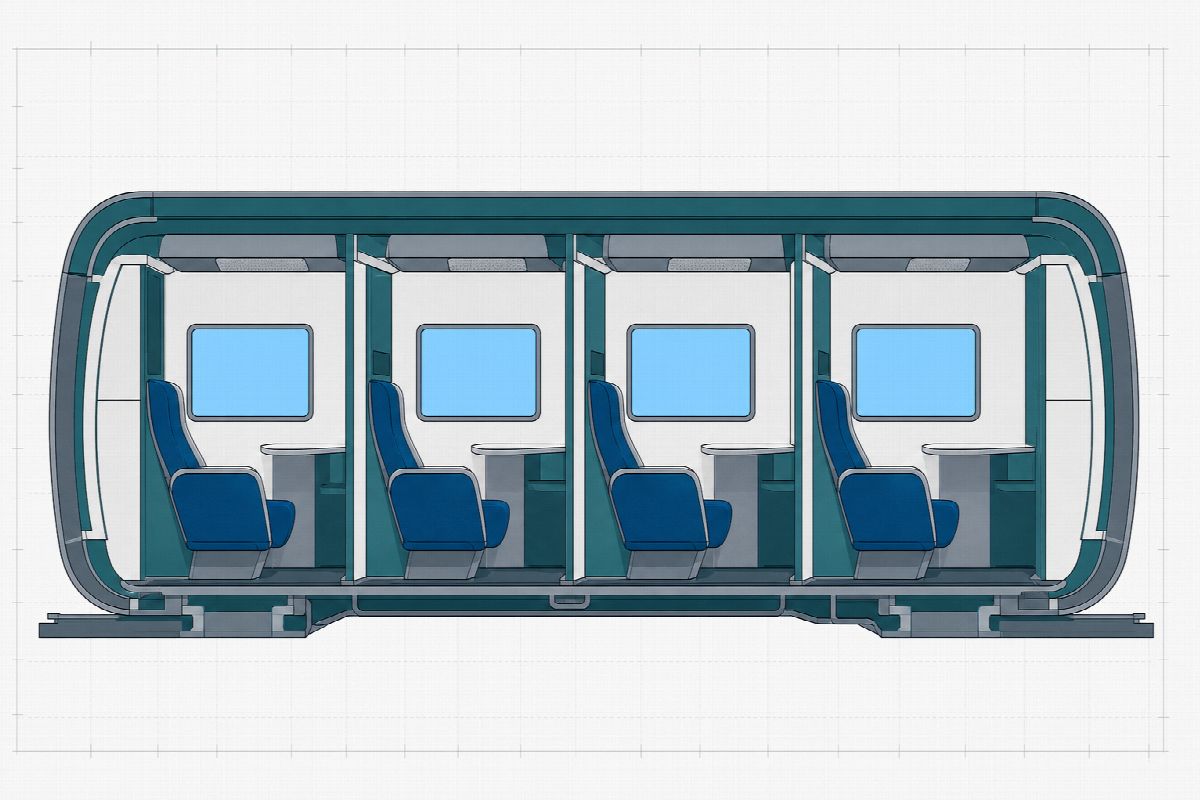
The traveller arrives at the airport early by choice, preferring a couple of hours in a stretching room to a longer day at the office. Before booking, she has asked several airlines for the total ecological footprint of the journey and used the answers to compare them, choosing the carrier flying modern aircraft on the most direct route. A named personal flight attendant is proposed to her in advance, matched on shared interests. She orders an evening snack of eco food, does yoga in a relaxation lounge, has a drink in the aircraft bar, then retires to a private sleeping booth. The flight is scheduled so that she arrives rested and without jetlag.
Three of those wishes turned into ordinary products within about fifteen years: per-journey emissions estimates shown at booking, paid access to airport lounges and wellness facilities, and lie-flat private cabins on long-haul routes. The personal attendant matched on taste did not materialise, and neither did scheduling flights around the passenger’s circadian rhythm rather than around slot availability.
Salokangas is explicit that this is method rather than prophecy: “The big trends of the future already exist. They are small signals and tendencies that still remain unnoticed by most people.” Trends, she argues, are not weather — they can be created deliberately, and weak signals can be strengthened and steered. That is a claim about marketing power, and it sits oddly next to a research exercise about what customers say they want.