Concept 05
Space hotel’s service ship
A fanciful vehicle attached to a business model that turned out to be broadly right.
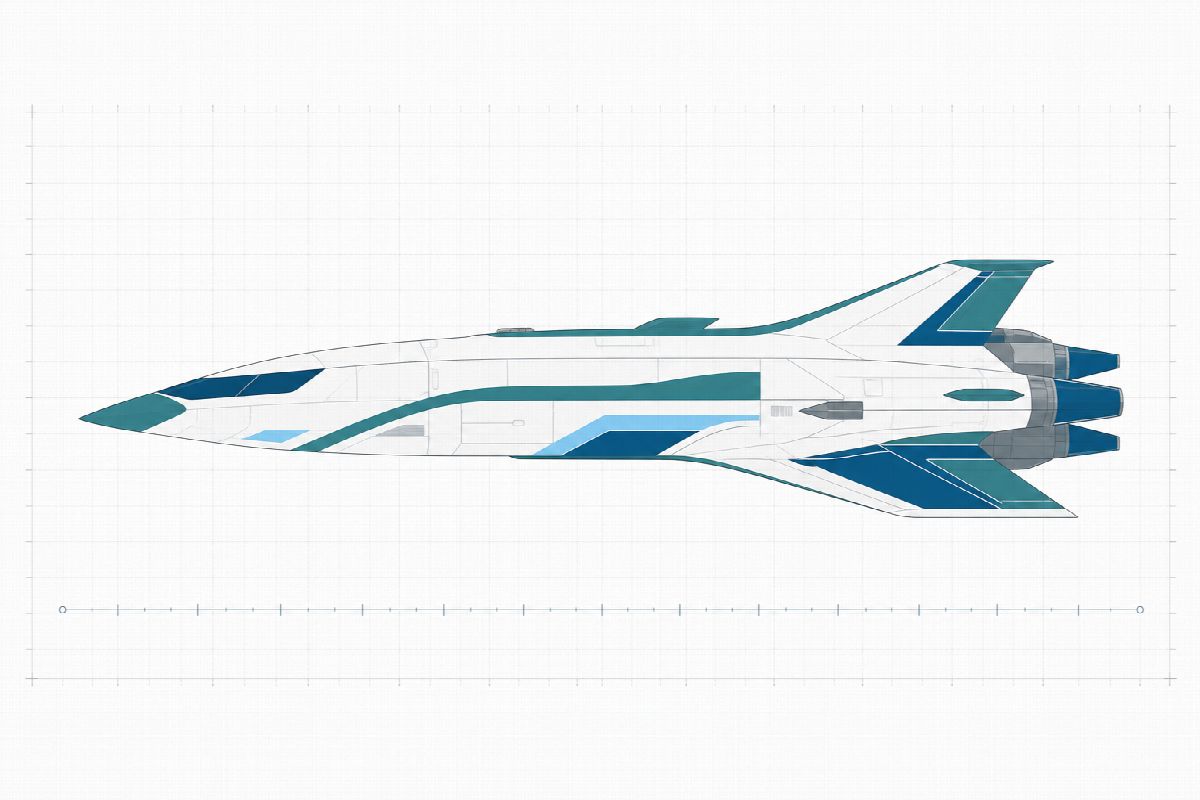
The only concept in the set that leaves the atmosphere. Service ships carry passengers directly to an orbital hotel, and the specification is unusual in describing the destination in more detail than the vehicle.
The ships are designed to operate at high speed at all levels of the atmosphere. The shape is described as arrow-like with aerodynamic, soft curves, to minimise air resistance and limit heating of the fuselage. And then the detail that gives the concept its character: “The ships have no special comforts, and no food or drinks are served.”
The hotel
It sits at an altitude of approximately 500 kilometres, in an orbit taking it around the Earth every nine hours. Guests stay four days on average, orbiting ten times in weightlessness.
Facilities include restaurants, recreational areas, an auditorium, a health station and greenhouses. There are 450 beds for tourist use. From a double cabin window guests can look out at space, and a display screen shows details of the Earth’s surface below. The specification notes, without elaborating, that the space hotel is a popular honeymoon destination.
Specification as published
| Passenger seats | 100–140 |
|---|---|
| Length | 48–52 m |
| Wing span | 28–33 m |
| Height | 12–16 m |
| Emissions | 0 |
| Flight time to 500 km altitude | approx. 20–25 minutes |
| Flights per week | 3–6 |
| Operating range | One journey plus 110–130% margin |
| Main engines | 2–3 hydrogen or hydrocarbon |
| Auxiliary engines | One hundred, concealed |
The numbers that are right
More than expected. An altitude of 500 km is a real low Earth orbit, comparable to where crewed stations operate. A 20 to 25 minute climb is the right order for reaching orbit. And the fuel margin — one journey plus 110 to 130 per cent — is a properly conservative reserve for a vehicle with nowhere to divert.
The nine-hour orbital period is the figure that does not work. At 500 km an orbit takes roughly 94 minutes, not nine hours; a nine-hour period corresponds to an altitude many times higher. The stated ten orbits over a four-day stay follows from the wrong period. At the specified altitude a guest would complete about sixty.
The hundred concealed auxiliary engines are the other oddity, unexplained in the specification. Attitude control in orbit does need many small thrusters, so the idea is not absurd, but a hundred is a large number to leave without a stated function.
The business model was the accurate part
Commercial human spaceflight did become a real, if small, industry. Suborbital flights carrying paying passengers began operating, and private crewed missions to orbit followed. The scale is nothing like this concept: single-figure passenger counts rather than 140, and no hotel.
What the specification got right is the shape of the product. A short, uncomfortable ride to a destination that is itself the experience, sold at a frequency of a few flights a week, is exactly how those services were structured. Helavuo’s decision not to serve food is the sharpest observation in the whole fleet: on a twenty-minute climb under acceleration, catering is not the point, and the ship is a lift rather than a hotel.
Orbital accommodation has been proposed repeatedly since, in the form of commercial modules attached to existing stations and free-flying stations intended partly for visitors. Nothing with 450 beds has been built or seriously costed.
The honeymoon line
It is worth noting because it is the one place in the specification where somebody thought about who would actually go. A four-day stay, a double cabin with a window, and weightlessness describe a particular customer, and the concept says so in a single sentence before returning to engine counts.
Set against the rest of the fleet, this concept is the one whose failure is least about engineering. The vehicle is buildable in principle; what is missing is a reason to move a hundred and forty people at a time to a destination that does not exist.