Concept 02
A600-850 short-haul concept
Ordinary airliner numbers, with a vertical take-off mode that solves a problem this aircraft does not have.
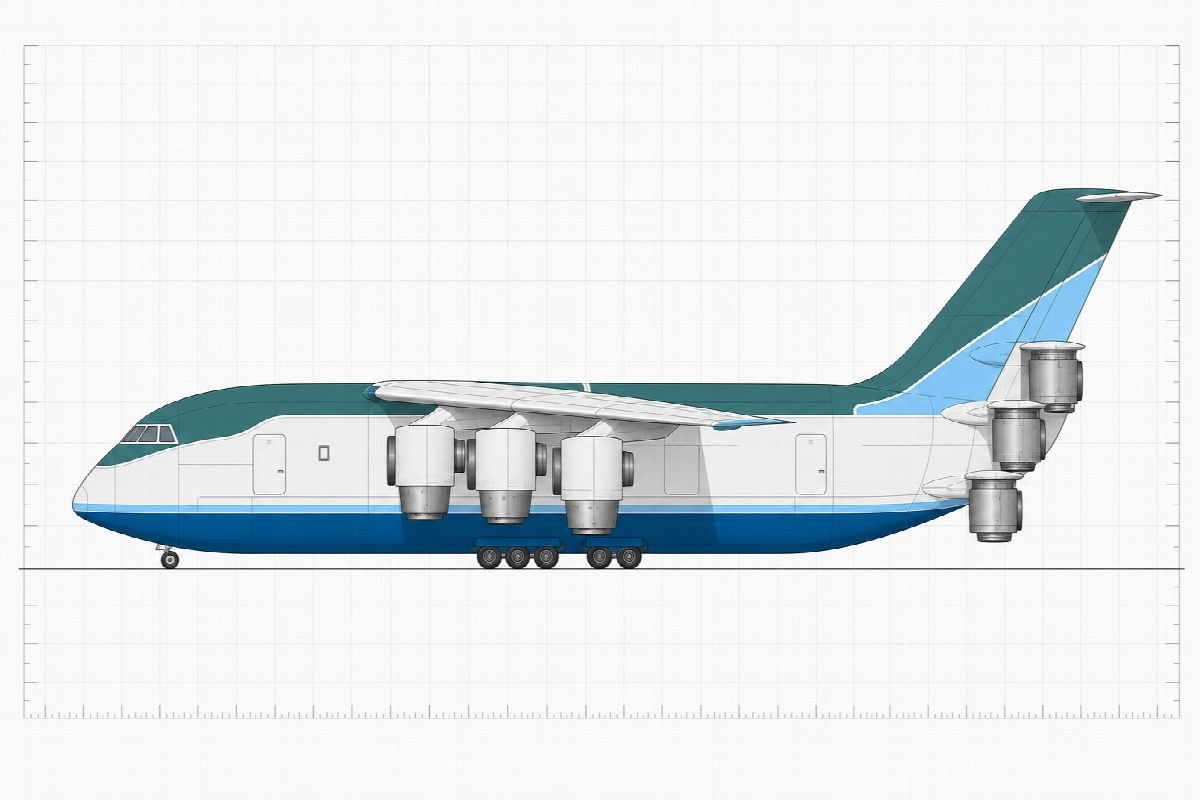
The short-haul counterpart to the supersonic design, published as the Finnair A600–850. Same passenger capacity, ordinary cruise speed, and the ability to take off either along a runway or vertically.
It is specified as zero-emission, with electricity generated by solar panels on the outer surface and all materials 100 per cent recyclable — the same assumptions as its long-haul sibling, applied to a much less exotic aircraft.
The engine arrangement
This is the concept’s substance. Four large turning engines sit under the aircraft and four smaller ones behind. The under-fuselage engines rotate 26 degrees horizontally and 55 degrees vertically, which the specification says stabilises control at lower flight speeds.
For a vertical departure the engines rotate to point downward and the four smaller rear engines extend out of the aircraft’s tail section. The take-off power figures reflect how much harder that is: 4 × 530 kN along a runway, against 8 × 850 kN vertically — roughly three times the installed thrust to leave the ground without a roll.
The cabin
About half of the 600 to 850 passenger places are in cabins for one to four people, with internet and satellite links. Some have real windows; others use audio-visual windows showing the sky or the ground below. Those screens double as displays for television or for events held in the aircraft’s restaurant.
Specification as published
| Passenger seats | 600–850 |
|---|---|
| Length | 81.70 m |
| Wing span | 77.90 m |
| Height | 31.60 m |
| Maximum take-off weight | 322,000 kg |
| Cruising speed | 890 km/h |
| Maximum cruising level | 13,800 m |
| Runway length, take-off | 2,100 m |
| Runway length, landing | 1,300 m |
| Flying range | 9,600 km |
| Take-off power, runway | 4 × 530 kN |
| Take-off power, vertical | 8 × 850 kN |
| Take-off speed, runway | 270 km/h |
| Landing speed, runway | 195 km/h |
Where the specification is realistic
More of it than the headline suggests. A cruise of 890 km/h and a ceiling of 13,800 metres are ordinary airliner figures. A 9,600 km range is a real long-thin-route number. Length 81.70 m and a 322,000 kg maximum take-off weight put it in the same class as the largest aircraft actually flying when it was drawn.
The unusual figure is the wing span at 77.90 m against a length of 81.70 m — almost square in plan, where conventional airliners are longer than they are wide. That follows from vertical take-off: the lifting engines have to be distributed across a broad structure.
The problem with the concept
Vertical take-off at this scale is where it breaks, and the numbers say so. Installing 6,800 kN of vertical thrust to lift 322,000 kg means carrying engines sized for a manoeuvre lasting under a minute through every hour of cruise, at a weight and drag penalty paid on the entire flight.
The stated runway requirement undermines the case further. If it can leave the ground in 2,100 metres conventionally — well within the capability of the airports a 600-seat aircraft would serve — the vertical mode is solving a problem this aircraft does not have.
Nothing of this class was built. Where vertical take-off did become real in civil aviation it went the other way entirely: very small electric aircraft carrying two to six people, distributing lift across many small rotors, exactly as in the concept for an aircraft for everyone. Scale turned out to be the deciding variable, and this design is on the wrong side of it.
The audio-visual window, revisited
The screen-instead-of-glass idea appears on three of the five concepts, and here it is used to justify private cabins on a short-haul aircraft — a passenger without a real window is offered a zoomable view instead.
The engineering argument for it is stronger than the entertainment one and is not made here. Windows are structurally expensive: every aperture is a stress concentration requiring reinforcement, and a windowless fuselage is lighter and cheaper to build. That is why the idea kept resurfacing in real research programmes after 2008, and why it has still not shipped — passengers, asked directly, keep saying they want the window.