Section 03
Flying is an adventure
Two outsiders to airline operations on travel as something other than transport.
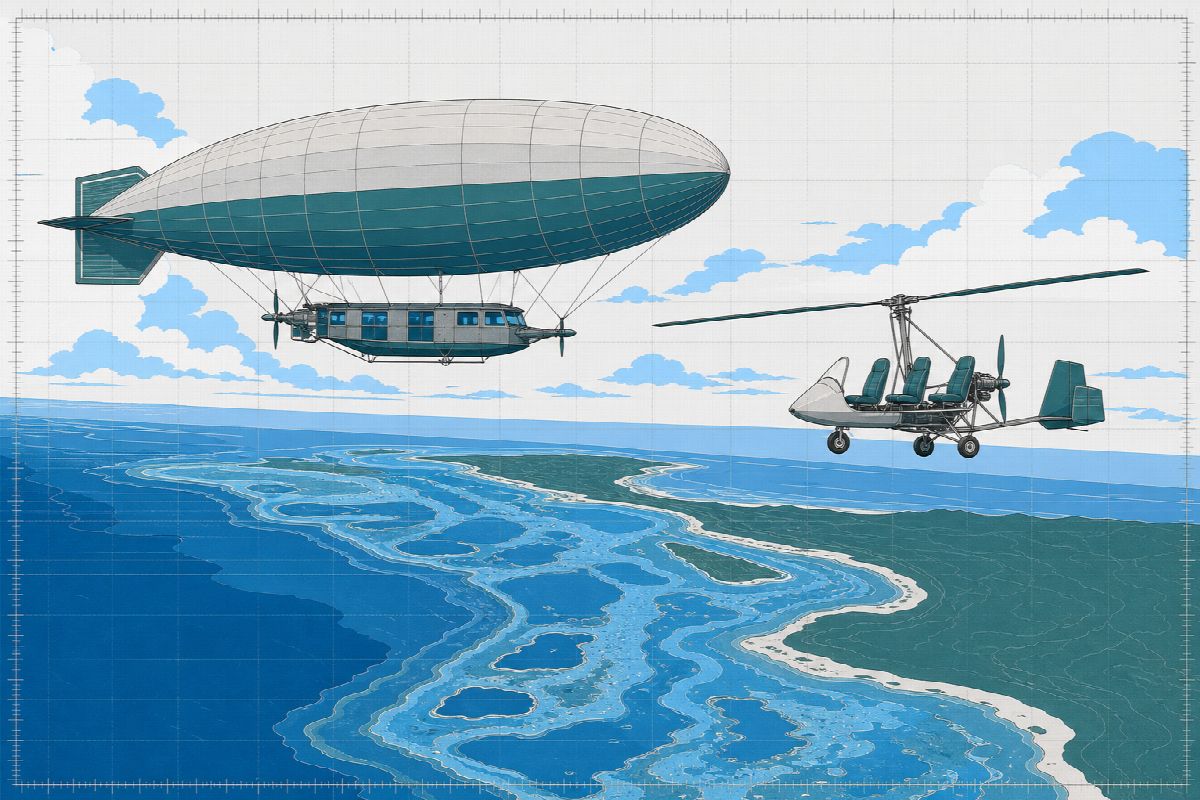
“The purpose of traveling is not always the destination.” The section argues that speed is only one of the things people want from flying, and that a century of optimising for it may have crowded out the alternatives: “Sometimes it is necessary to get anywhere in the world in less than three hours, but sometimes it can be preferable to glide above the sea and look down on the glittering coral reefs from a cruising airship.”
Both contributors here are outsiders to airline operations. Kauko Helavuo is the graphic designer who drew the project’s five concept aircraft. Heikki Haapavaara is a journalist and chairman of the Finnish Association of Aviation Journalists. Neither was asked to be realistic.
Two contributions
-
01
My passion — the future of flying
Kauko Helavuo on why he draws the future rather than predicts it. “The future creates positive energy and it gives us the freedom to enjoy the world of knowledge and imagination.”
-
02
Haapavaara’s imagined account of Liisa Li checking in at the Helsinki Space and Airport for a flight to orbit — written as fiction, and explicitly labelled as such.
The airship idea, and the Air Pod
Two vehicles named in the section’s introduction never appear in the concept fleet. One is the cruising airship, offered as the slow counterpoint to supersonic travel. The other is the “personal car-sized Air Pod”.
The airship line is the more interesting of the two, because lighter-than-air travel keeps being revived for exactly the reason given here: it is unhurried and it is efficient, and both matter more when carbon is priced. The pattern since 2008 has been repeated announcement and limited service.
The Air Pod fared better in the sense that something like it was built. The three-seat hybrid in Helavuo’s fleet — see an aircraft for everyone — is recognisably the small electric vertical-take-off class that entered certification programmes in the 2020s, which is roughly when he said the first versions would appear.
Fiction, clearly marked
Haapavaara’s piece is the only openly invented thing in the project, and it says so: he “tells an imaginary story of Liisa Li’s trip into the space here but he will travel there himself in 2012”. The 1923-to-2008 arithmetic that gave the site its name gets an echo in that aside, and it is a reminder of how close commercial spaceflight felt in 2008. The date passed without the trip.
Nothing in the section pretends the fiction is a forecast. That distinction is maintained more carefully here than in some of the technical material elsewhere on the site.
Helavuo’s technical bets
The essay is where the concept fleet’s assumptions are stated plainly, and it is more specific than the drawings suggest. Helavuo expected fossil fuels to be abandoned almost entirely by the second half of the century, and inexpensive electricity to be used to produce hydrogen from water at scale. He put the keys to workable fusion power at 2030.
For propulsion he expected engines able to operate economically at 30 to 40 kilometres altitude at Mach 4 to 8, with electric motors on small aircraft, and speculated about a further class of engine generating thrust with no airflow and no combustion at all. The Mach 4.5 cruise on the A600–850 M comes directly from that assumption.
Two of those bets have not come in. Fusion did not arrive on a 2030 schedule, and hypersonic airliners at 40 kilometres remain absent. The electric small aircraft did arrive. Solar cost and capacity moved in the direction he described, and green hydrogen from electrolysis became a real industrial programme rather than a thought experiment, if a smaller one than he assumed.
He is candid about method: decades of following technology, a career in marketing and visual communication, then “a considerable amount of lateral thinking, creative imagination and work”. The essay opens with him watching birds in a garden as a child and drawing delta-wing jets in comic strips at eleven. That is not a forecasting methodology and it does not claim to be.