Concept 01
A600-850 M supersonic long-haul concept
The project's poster aircraft, and the widest gap in the set between the drawing and the numbers.
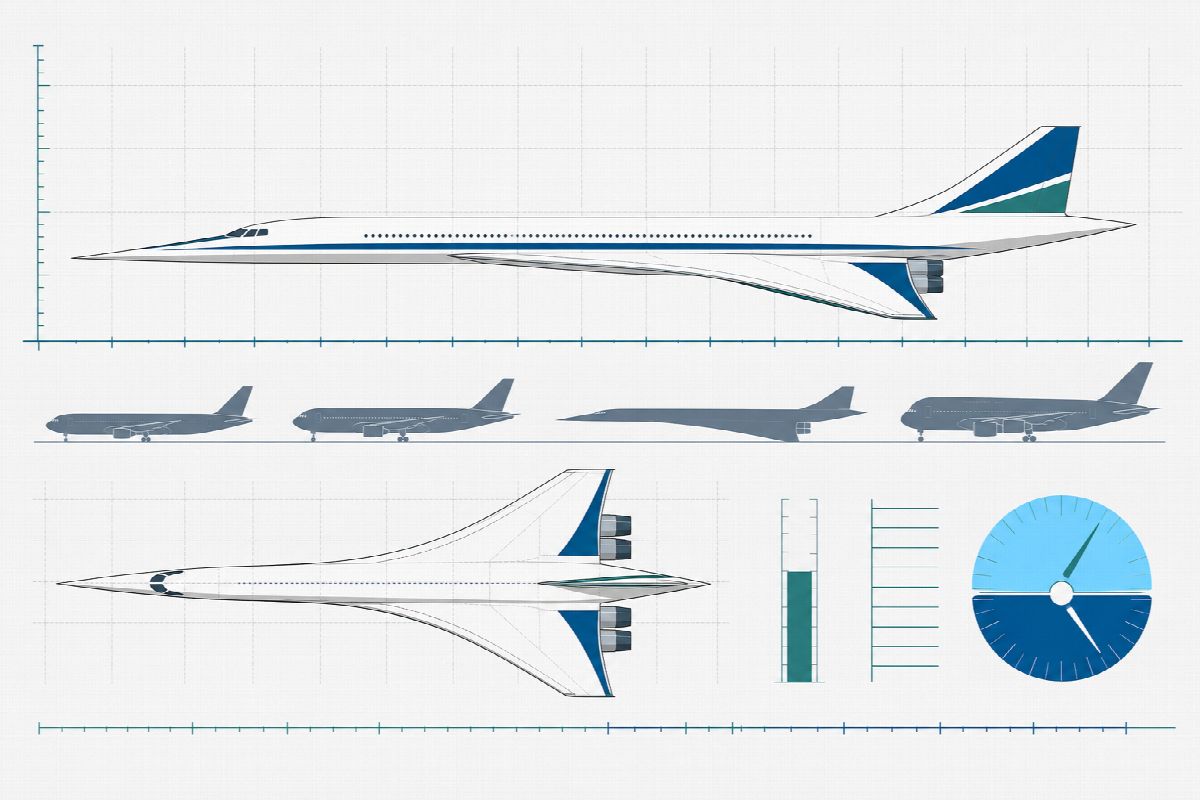
The most ambitious concept in the set, published as the Finnair A600–850 M: a wide-bodied, zero-emission supersonic aircraft for long-haul routes, cruising at Mach 4.5.
The fuselage is specified as a super-light, super-strong nanoceramic material chosen to withstand the heat of air friction at that speed. The wings are “intelligent” and partly elastic, changing shape according to flight speed and weather to save energy and cut noise. Electricity comes from solar panels on the aircraft’s surface, and all materials are stated as 100 per cent recyclable.
The cabin
The aircraft is described as partly two-level, with entertainment and wellness facilities on a deck below the main cabin. Those lower areas have no glazing; audio-visual windows substitute, giving zoomable views of the sky or downward to the ground.
The seats are the concept’s most detailed feature. They adjust to a passenger’s weight, height and age, assist them in standing up, and can measure pulse, blood pressure and body temperature or provide light massage and heat treatment. Each has internet and satellite connectivity and a 20-inch three-dimensional display in the backrest. Passengers can raise a sound-insulated barrier between their seat and the next so that conversation cannot be overheard.
Specification as published
| Passenger seats | 600–850 |
|---|---|
| Length | 126.30 m |
| Wing span | 60.70 m |
| Height | 36.80 m |
| Fuselage width at centre | 8.3 m |
| Maximum take-off weight | 310,000 kg |
| Cruising speed | Mach 4.5 |
| Maximum cruising level | 39,000 m |
| Runway length, take-off | 3,100 m |
| Runway length, landing | 2,400 m |
| Flying range | 26,600 km |
| Take-off power | 2 × 930 kN |
| Take-off speed | 310 km/h |
| Landing speed | 265 km/h |
Reading the numbers
Two figures stand out as unusual even for a concept. A cruising level of 39,000 metres is far above airliner altitudes and above most of the atmosphere; Concorde cruised around 18,000 metres. And a cruise of Mach 4.5 is roughly twice Concorde’s, which puts the airframe into the thermal regime the nanoceramic skin is invoked to handle.
The 26,600 km range is close to the circumference of the Earth at the poles, which appears to be deliberate: the aircraft is specified to reach anywhere without stopping.
The propulsion figures are the weak point. Two engines of 930 kN take-off thrust each, for a 310,000 kg maximum take-off weight, on an aircraft expected to sustain Mach 4.5 at extreme altitude — no engine of that description exists, and none of the assumed types would be a conventional turbofan. The specification does not say what the engines are, only what they produce.
What happened instead
Commercial supersonic flight ended in 2003 with Concorde’s retirement and has not resumed. Several programmes have since worked on smaller supersonic business aircraft in the Mach 1.4 to 2.2 range, well below this concept, and the binding constraints have been the ones this specification does not mention: overland sonic boom regulation, engine emissions and certification noise limits at take-off.
The intelligent seat has aged better than the airframe. Seats that adjust automatically, connect to networks and carry large personal displays are ordinary now. The health monitoring built into the seat did not arrive, though wearable monitoring made the seat an unnecessary place to put it.
The sound-insulated barrier between adjacent seats is the detail worth keeping. Privacy dividers became the defining feature of premium long-haul cabins, arriving as fixed shells rather than as something a passenger raises on demand.
Why this one was the poster aircraft
Of the five drawings this is the one that circulated, and it is easy to see why. It is the only concept that answers the project’s question with a single image: an aeroplane that is obviously not from now, doing something an aeroplane cannot currently do, without looking like a spacecraft.
It also carries the largest gap between drawing and specification. The picture shows a graceful delta; the numbers describe a vehicle operating at four and a half times the speed of sound at 39,000 metres, a combination that puts it closer to a scramjet research programme than to an airliner. Helavuo drew the aircraft people wanted to see and then wrote down what it would have to do.