Section 05
Flying is good business
The only section that treats the future as a management problem rather than an engineering one.
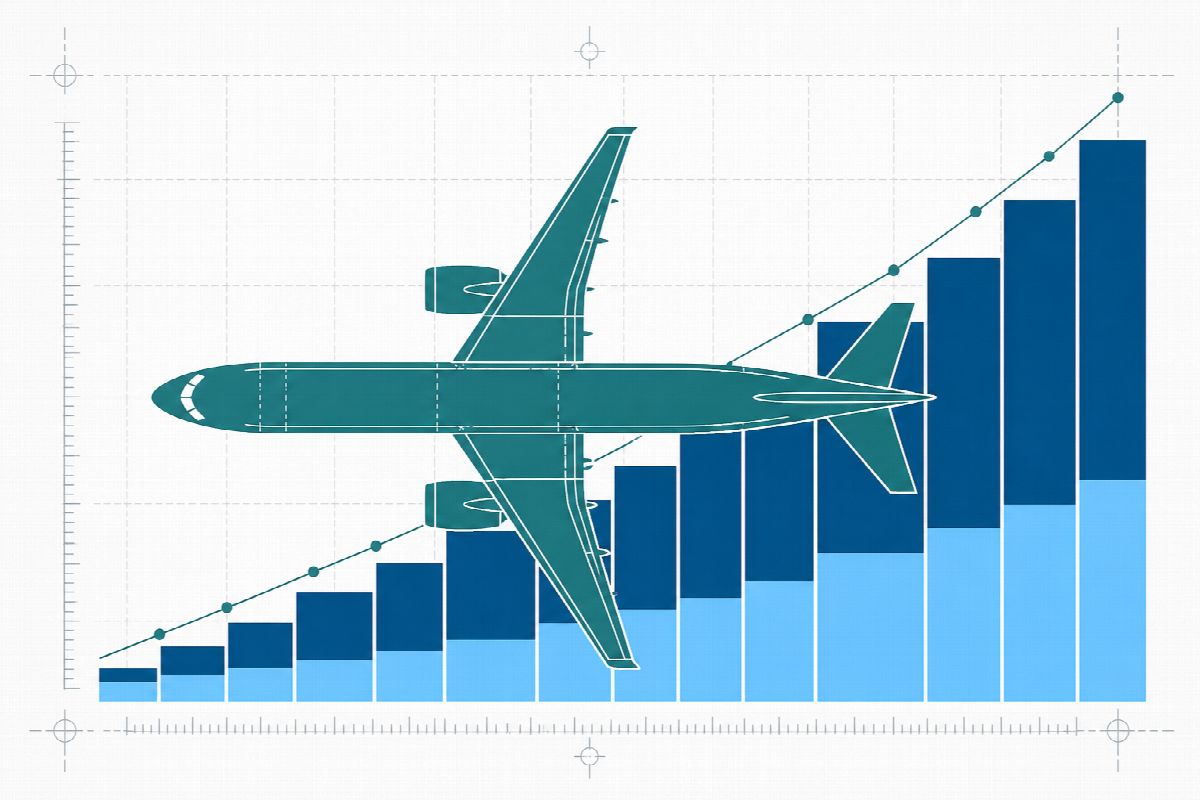
The section’s argument is that sustainability arrives through the income statement or not at all. “Business continuity is based on profitability. An ability to create visions is one of the prerequisites for success. Corporate social responsibility has traditionally been considered as a phenomenon separate from core business.”
Then the thought experiment that gives the section its title: “But what would a CEO do if including the principles of sustainable development in his company’s core business would triple a single day’s sales? It is hard to resist profit.”
Contribution
-
01
Sirpa Juutinen, Director of Corporate Social Responsibility Services at PricewaterhouseCoopers Oy, on responsibility moving from outside the business to inside it.
Wuggetzer on business models
The section also carries a statement from Ingo Wuggetzer, then Head of Cabin Innovation and Design at Airbus Engineering, and it is the most specific prediction in this part of the project:
“In the future there’s going to be larger variety of choices for travel; flying will be much more flexible. Behind these various travel opportunities there will be different business models. For the individual passenger, for instance, leisure travel could be free of charge on cruise ships carrying thousands of customers. The business is based on rental fees of the shops, wellness areas and restaurants and advertisements. In addition, airlines charge for special personalised services.”
Ingo Wuggetzer, Head of Cabin Innovation and Design, Airbus Engineering
The headline version — free leisure flights cross-subsidised by retail — did not happen. The underlying mechanism did, comprehensively. Unbundling the fare and charging separately for seat selection, baggage, boarding order and onboard service became the dominant model across large parts of the industry, and ancillary revenue became a reported line rather than a footnote. Wuggetzer described the direction correctly and overshot the degree.
Where the argument is weak
The triple-a-day’s-sales framing assumes the profitable move and the sustainable move point the same way once someone does the arithmetic. Aviation is the awkward case for that assumption, because the cheapest fuel was for a long time the dirtiest, and the industry’s own decarbonisation path depends on fuels that cost more than the kerosene they replace.
Juutinen’s essay is more careful than the section introduction that frames it. She describes responsibility being absorbed into core business as an observed shift in corporate practice, not as a claim that markets resolve it automatically. The introduction turns that into something closer to a promise.
Read against the other four sections, this one is the outlier in a specific way: it is the only place in the project where the future is treated as a management problem rather than an engineering or a values problem.
Carrotmob, and the carrot instead of the stick
Juutinen’s essay hangs on a real example rather than a hypothetical, which is what makes it worth reading. Carrotmob was a consumer movement that used Facebook, MySpace, Twitter and similar networks to concentrate purchases on a single day at a company that had agreed to spend part of the resulting profit responsibly. Where campaigning organisations had historically used the stick, this used the carrot.
Her interest is in the mechanism: online networks, fast information flow, the ability to mobilise globally, and a reward for good behaviour rather than a penalty for bad. For the company the payoff is cash flow and brand. She notes that the effect decays unless the company keeps reading what she calls the weak signals of changing expectations, because a single good act buys a single good day.
She is careful about how much this proves. In her own words the approach “may not solve the global challenges of sustainable development, but it sends a fascinating signal nevertheless”.
Carrotmob itself did not scale into a durable institution. The pattern did. Coordinated consumer pressure organised through social platforms became a standard feature of corporate reputation management, and the ratings and disclosure regimes that followed made responsibility a reported metric rather than a voluntary gesture. The direction Juutinen pointed at held; the specific vehicle she pointed at did not survive.