Concept 04
An aircraft for everyone
The modest design, the accurate date, and the only concept in the fleet that needed no new physics.
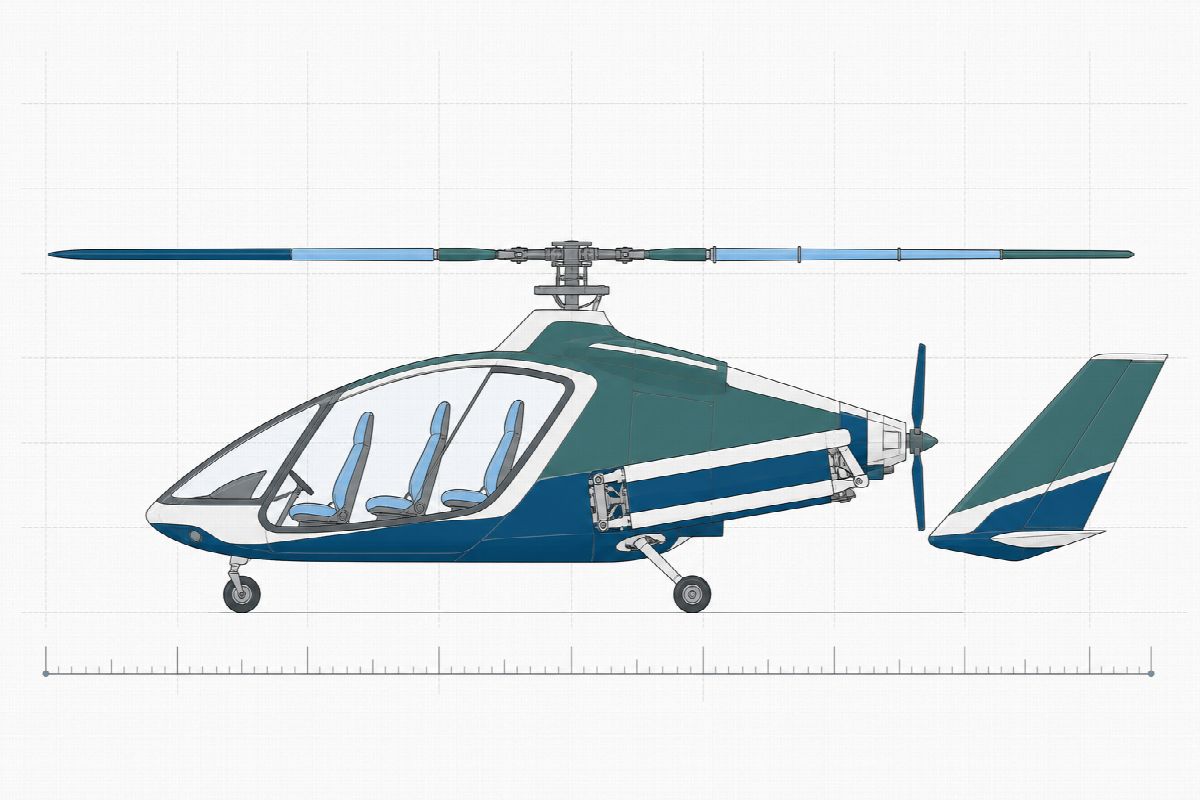
The smallest concept in the set and the only one that mostly came true. Described as an efficient combination of a helicopter and a small aircraft, with first versions expected in the 2020s.
The reasoning behind that date is economic rather than technical. Because of low manufacturing and running costs and high reliability, the specification says, the aircraft’s basic structure and design will remain almost unaltered for decades — a design intended to be built in volume and left alone, rather than replaced every few years.
Structure and power
About 85 per cent of the outer surface is covered with electricity-generating solar cells, specified as elastic full-spectrum thin film with an efficiency coefficient of up to 92 per cent. The fuselage is new-generation carbon fibre. Power is electric, from solar energy and a hydrogen fuel cell, driving two tunnelled pusher propellers at low noise.
The distinctive feature is the variable rotor. A computer adjusts blade length to suit load, take-off and landing speed, or slow flight. In horizontal cruise the blades are at their shortest and held stationary to minimise drag, with the pusher propellers providing thrust.
Specification as published
| Passenger seats | 3 |
|---|---|
| Length | 7.60 m |
| Wing span | 8.80 m |
| Height | 2.90 m |
| Rotor blade length adjustment | 1.30–3.60 m |
| Cruising speed | 240 km/h |
| Maximum speed | 320 km/h |
| Maximum cruising altitude | approx. 5 km |
| Aircraft weight | 340 kg |
| Load carrying capacity | 370 kg |
| Emissions | 0 |
Also specified
| Landing gear | Retractable |
|---|---|
| Wings | Folding |
| Night flying | Fully equipped |
| Controls | Fully automatic |
| Water floats | Optional accessory |
How close it came
Closer than anything else in the project. Small electric vertical-take-off aircraft in the two- to five-seat class entered flight testing during the 2020s and went into certification programmes with civil aviation regulators, on roughly the schedule given here. The general configuration — electric, quiet, distributed rotors for lift, a separate cruise propulsor, automated controls — is the one that emerged.
Several of the detailed figures are also in the right region. A cruise of 240 km/h and a ceiling around 5 km match the operating envelope of real designs in that class. A 370 kg payload on a 340 kg empty weight is aggressive but the right order of magnitude for a three-seater.
Two specifics were wrong in instructive ways.
The 92 per cent solar efficiency is not achievable. Single-junction cells are bounded near 33 per cent by thermodynamics, and the best multi-junction laboratory cells under concentrated light reach the high forties. Thin-film modules of the flexible kind described here run well below that. The concept needs the figure because the aircraft is supposed to fly on sunlight collected by its own skin; real electric aircraft in this class charge on the ground and treat any solar contribution as marginal.
The variable-length rotor also did not appear. Real designs solved the same problem — efficient hover and efficient cruise from one airframe — by tilting rotors or by stopping some and using others, both mechanically simpler than a blade that changes length in flight.
Why the small one was the good prediction
The pattern across the five concepts is that the modest design was the accurate one, and the reason is visible in the specification. This aircraft asks for no new physics. It needs cheap solar cells, good batteries or fuel cells, light composite structure and capable flight computers — four things that were already improving fast in 2008 on curves anyone could extrapolate.
The other four concepts each require at least one thing that does not exist: a nanoceramic airframe, a Mach 4.5 engine, a 422,000 kg aircraft carrying 2,400 people, or a fusion drive. Helavuo’s essay puts fusion at 2030 and it is that assumption, not his draughtsmanship, that dates the rest of the fleet.