Concept 03
A1700-2400 Cruiser concept
The largest design in the set, and the only one whose specification spends more words on parachutes than on engines.
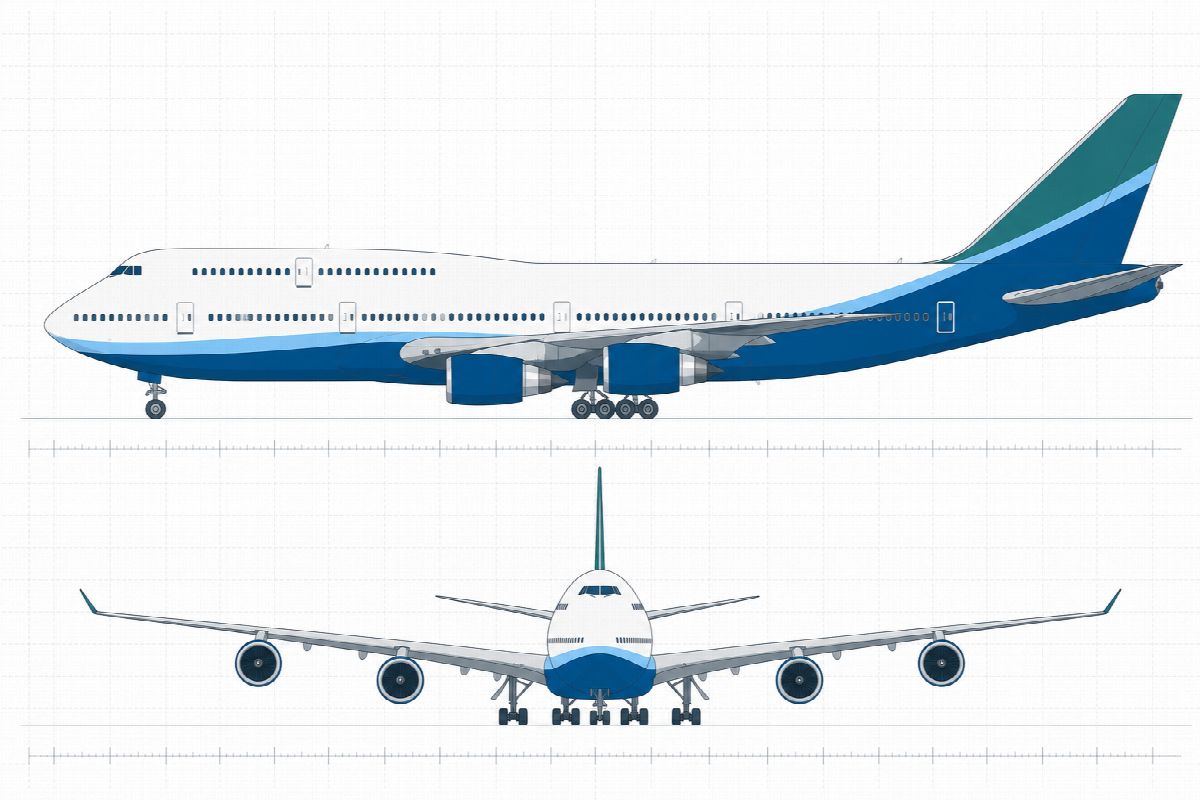
The largest concept in the set, published as the Finnair A1700–2400 Cruiser: a charter aircraft for 1,700 to 2,400 passengers, with turning engines mounted forward, designed for both gliding and vertical take-off, and able to land on water in an emergency.
Every passenger place is in a cabin for one to four people. Each cabin has its own toilet and shower along with internet and satellite links. Some have windows; all have audio-visual windows offering zoomable views of the sky or the ground, which double as screens for television or for events held in the aircraft’s restaurant.
The public facilities are listed at length: hologram theatres, restaurants, bars, shops, meeting rooms, a beauty parlour, a first-aid station, gymnasiums and a quiet room. The aircraft is conceived as a venue rather than as transport, which is what the word cruiser is doing in the name.
Propulsion
Seven engines under the vessel rotate up to 26 degrees vertically or horizontally, for stability at low speed. For a vertical departure the two-part upper and lower covers of the central engine bay open and withdraw into the fuselage; once the aircraft transitions to horizontal flight the central engines stop, the covers close, and the bay then acts as a lifting surface. For a conventional runway departure the central engines are not used at all.
As with the other concepts, electricity comes from solar panels on the outer surface and all materials are stated as fully recyclable.
The safety system
This is the part of the specification that gets the most words, and it has no equivalent anywhere else in the set.
The central take-off engine bay carries three large smart parachutes, each 80 by 20 metres when open. They are luminescent and cell-structured, with the cells filling with helium after launch. An automatic alarm system reports an accident to emergency channels, transmits location data, sends live images from miniature cameras to communications satellites, and sends a real-time report from the aircraft’s central computer to emergency centres and to the airline.
If there is enough altitude the parachutes steer the descent toward the safest available place. In a fall or emergency landing on ground or water, 200 large cell-structured airbags deploy from the underside at about 40 metres. These are also luminescent.
Specification as published
| Passenger seats | 1,700–2,400 |
|---|---|
| Length | 118.30 m |
| Width | 98.70 m |
| Height | 32.60 m |
| Maximum take-off weight | 422,000 kg |
| Cruising speed | 160–750 km/h |
| Maximum cruising level | 14,800 m |
| Runway length, take-off | 2,100 m |
| Runway length, landing | 1,300 m |
| Flying range | 21,600 km |
| Take-off power, runway | 7 × 530 kN |
| Take-off power, vertical | 12 × 850 kN |
| Take-off speed, runway | 210 km/h |
| Landing speed, runway | 165 km/h |
The interesting number
The cruising speed is given as a range, 160 to 750 km/h, and no other concept in the set does that. A minimum cruise of 160 km/h is slower than most light aircraft and implies the vessel can loiter almost like an airship — which fits the section introduction’s image of gliding above a coral reef, and fits the word cruiser better than the top figure does.
The weight figure is the one that does not work. At 422,000 kg maximum take-off weight for up to 2,400 passengers, the aircraft allows roughly 175 kg per passenger for everything: seat, cabin structure, private bathroom, share of the restaurants and theatres and gymnasiums, baggage, and the passenger. A current wide-body allows two to three times that per seat with no private bathroom at all.
What the industry did instead
It went the other way. The largest airliner ever built entered service the year before this concept was published, and orders for it stopped within a decade; production ended in 2021. Airlines chose efficient twin-engined aircraft flying thinner routes more often over very large aircraft concentrating passengers into hub-to-hub flows.
The cabin ideas fared better than the airframe. Private suites with direct aisle access became the long-haul premium standard, and onboard showers were fitted on a small number of aircraft in first class — arriving as a scarce luxury rather than as standard issue for 2,400 people.